Concrete driveways in Palm Coast, built on compacted sand and pitched to the swale
A driveway here lives on flatwoods sand between a house and a roadside swale. We recompact the base, reinforce the slab, pitch it so the water goes where the city wants it, and pour the apron to the culvert detail — for a price that's in writing before the truck is ordered.
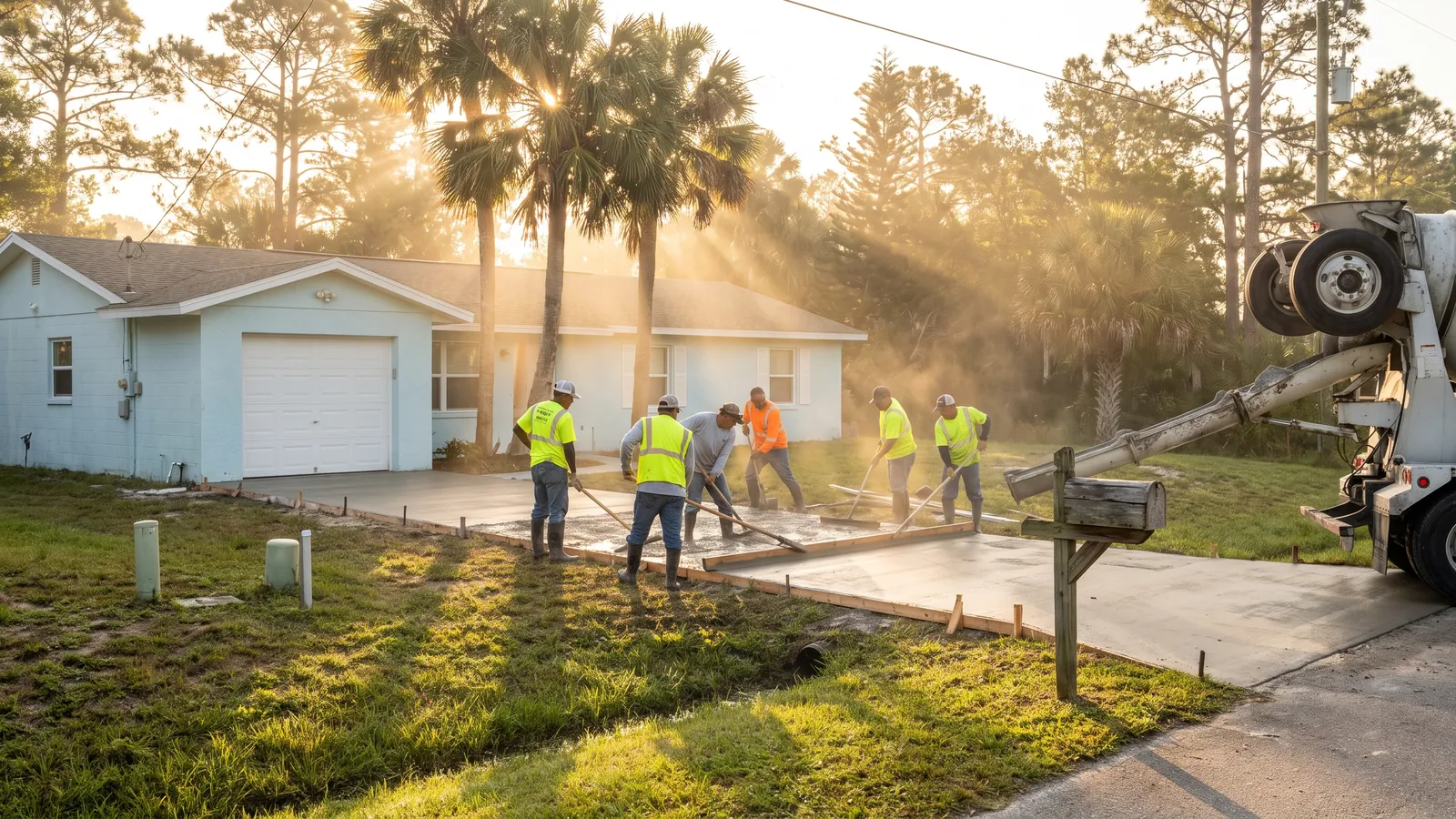
Almost every driveway in Palm Coast runs the same route: from the garage of a slab-on-grade block home, across a quarter-acre ITT lot, over the roadside swale on a culvert pipe, and out to the street. The original 1970s and '80s pours in Palm Harbor, the Woodlands and Belle Terre are on their second or third owner and showing it — settled at the apron, cracked where a root came through, spalled where the sprinklers hit it every morning for forty years. The 2000s builds in Seminole Woods, Lehigh Woods and Indian Trails were often poured fast on sand that was never compacted, with a downspout aimed at the corner. And the thousands of infill lots still being built out need a driveway that will actually last, on a street where the swale detail is not optional.
Our driveway is the whole system, not just the top four inches. We cut and haul the old slab, dig out any organic muck or loose fill, bring the sand base up in compacted lifts to a grade that stays above the wet-season water table, set forms to a fall of about a quarter inch per foot away from the garage, lay fiber-reinforced 3,000 psi concrete at four inches — five to six at the apron and wherever a boat or RV will sit — over welded wire or rebar, cut control joints on a grid no wider than ten feet so the slab cracks where we told it to, and broom-finish it for grip in the rain. If the driveway is new or wider than the old one, or touches the swale, we pull the city's driveway permit and call for the inspection. Then we seal it.
What's included
Old slab out, base rebuilt
Tear-out and haul-off, muck and loose fill removed, clean sand compacted in lifts — the part that decides whether the slab moves.
Pitched to the swale
About a quarter inch of fall per foot away from the house and toward the road, so water leaves the slab instead of pooling at the garage or the swale edge.
Fiber + steel, 4 to 6 inches
Fiber in the mix, welded wire or rebar in the slab, four inches on the lot and five to six at the apron and under boat and RV wheels.
Control joints on a grid
Saw-cut or tooled joints no wider than ten feet apart, plus an expansion joint against the garage slab and the city sidewalk if there is one.
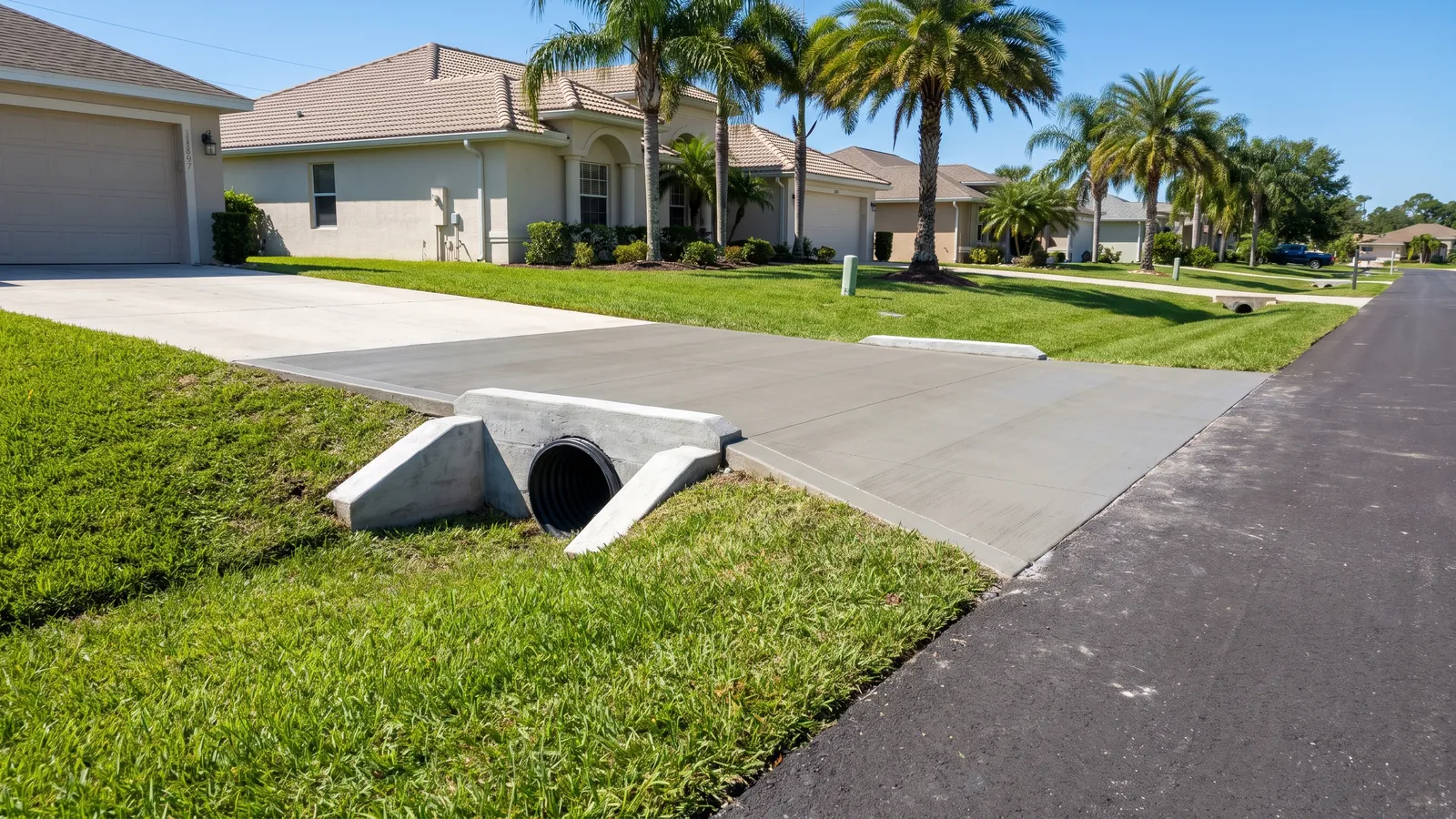
The swale apron done right
Pipe, mitered ends and apron to the city detail, permitted and inspected, so the swale keeps draining and the apron stays up.
Permit, cleanup, sealing
City permit where one applies, forms pulled, sand and debris off the street, and a penetrating sealer after the cure.
Concrete driveways cost in Palm Coast, FL
| Job | Typical price | Notes |
|---|---|---|
| New 2-car driveway, 4" broom finish (500–650 sq ft) | $5,000 – $8,500 | On-lot slab, base compacted |
| Replacement (tear-out + haul-off + new), 2-car | $6,500 – $11,000 | Tear-out $2.50 – $4.50 / sq ft |
| Widening or boat-side extension (150–300 sq ft) | $1,800 – $3,900 | Common in Seminole Woods and Palm Harbor |
| Apron across the swale with culvert pipe and mitered ends | $2,500 – $5,500 | Separate city permit |
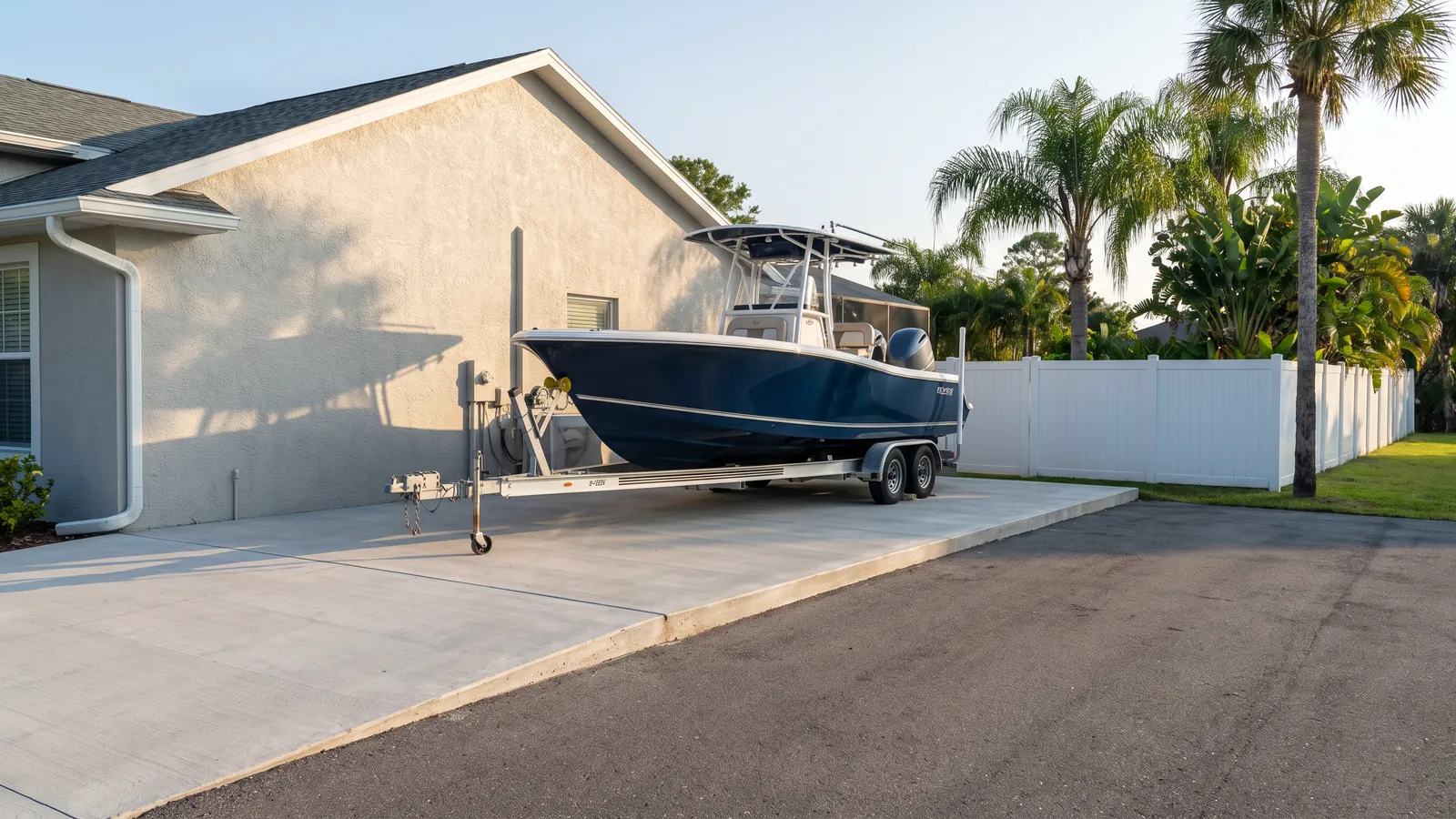
| Third-car or RV pad, 5–6" reinforced | $3,200 – $6,500 | Rebar, thicker slab |
| Stamped or colored driveway (600 sq ft) | $10,000 – $15,500 | See stamped concrete |
| Long run to a rear garage or flag lot (per extra 100 sq ft) | $850 – $1,400 | Pump may be needed |
These are 2026 Flagler County ranges so you can budget. Your written price is itemized — demolition and haul-off, base, thickness and steel, finish, joints, sealing, permit — and good for 30 days.
Recent work
Questions we get about concrete driveways
How long does a driveway replacement take?
Three to five working days for a typical two-car driveway: a day to cut and haul the old slab and rebuild the base, a day for forms and steel and the city's pre-pour look where a permit applies, the pour at first light on the third day, and a week before you park on it. Foot traffic is fine after 24 to 48 hours; cars after seven days; the boat after fourteen.
Do I need a permit to replace my driveway in Palm Coast?
Replacing an existing driveway in the same footprint is generally exempt in Palm Coast. A new driveway, a wider one, a second access, or any work in the roadside swale or right-of-way — the apron and the culvert — needs the city's driveway permit and inspection, and the contractor has to be registered with Building Services. We confirm with the city at (386) 986-3780 before every job and pull the permit when one applies; it's on the invoice.
Can I make the driveway wider for the boat?
Usually, on the lot. Palm Coast's Land Development Code limits how wide a driveway can be where it meets the street and how close it can run to the side property line, and the swale apron has its own rules, so the extra width generally happens on your side of the right-of-way and tapers back to the permitted apron. We measure your lot's numbers before we quote it, and if you're in Grand Haven, Plantation Bay or another association, the architectural committee signs off first.
Wire mesh or rebar?
Fiber in the mix plus welded wire mesh, set on chairs so it's actually in the middle of the slab and not lying on the sand, is right for a four-inch driveway that carries cars. Rebar on a grid is what we use at the apron, under boat and RV pads, and on any slab five inches or thicker. Anyone who quotes you a driveway with 'fiber only' at four inches on Palm Coast sand is quoting you cracks.
Why did my old driveway sink at the street?
The swale. When the culvert ends silt up or the swale erodes, water runs under the apron and takes the sand with it. Fixing the apron without fixing the drainage means doing it again in five years, which is why we look at the culvert first — and why the city makes the property owner responsible for it under code section 24-159.