Concrete or pavers on Palm Coast sand: an honest comparison
Pavers look wonderful the day they go in. Ask anyone in Palm Harbor with a 2005 paver driveway what it looks like now. Here's how the two actually behave on a Palm Coast lot — and where each one wins.
Cost
| Surface | 2026 installed, per sq ft | Typical 600 sq ft driveway |
|---|---|---|
| Broom-finished concrete, 4" reinforced | $8.50 – $13.50 | $5,100 – $8,100 |
| Concrete with a border or band | $10 – $15 | $6,000 – $9,000 |
| Stamped concrete | $16 – $25 | $9,600 – $15,000 |
| Concrete pavers on a compacted base | $14 – $22 | $8,400 – $13,200 |
| Travertine or natural-stone pavers | $22 – $35 | $13,200 – $21,000 |
Pavers cost more than broom concrete up front and about the same as stamped, and they cost more over time: a paver driveway on Palm Coast sand typically needs re-sanding of the joints every couple of years and a lift-and-relay of the sunken wheel paths within ten. A concrete driveway needs a reseal every two or three years and, if it was built on a compacted base, not much else.
How each one behaves on flatwoods sand
Sinking
Pavers are hundreds of small units on a bed of sand over a compacted base. Each one carries its own load, so where the wheels always land — the two tracks from the street to the garage — the base compresses and the pavers settle into ruts. On Palm Coast's poorly drained flatwoods sand, with a water table a few feet down and a swale beside the driveway, that happens faster: water softens the base, the tracks sink, and the apron over the culvert goes first. A reinforced concrete slab spreads the wheel load across the whole panel, so it doesn't rut; if the base under one corner fails, the slab bridges it until it can be foam-lifted.
Weeds, ants and roots
Every paver joint is an opening. Sand in the joints grows weeds, feeds ants — fire ants and ghost ants both colonize paver beds here — and lets roots from the oak in the front yard come up between the units. Polymeric sand helps for a while and washes out in the afternoon storms. Concrete has joints every eight to ten feet, sealed, and nothing lives in them.
Salt and the island
On the Hammock and in Flagler Beach both surfaces take salt. Pavers spall at the edges and the joint sand goes crusty; concrete, poured with a dense mix and proper steel cover and sealed with a marine-rated sealer, holds up better and longer. Coquina-look stamped concrete has become the island's default for that reason.
Repairs
Pavers win here: a single damaged unit can be lifted and replaced without a trace. A concrete panel that's damaged is foam-lifted if it's sound or cut out and replaced with a dowelled section that will never quite match in color. Stamped concrete is the hardest to patch invisibly.
Where stamped concrete fits
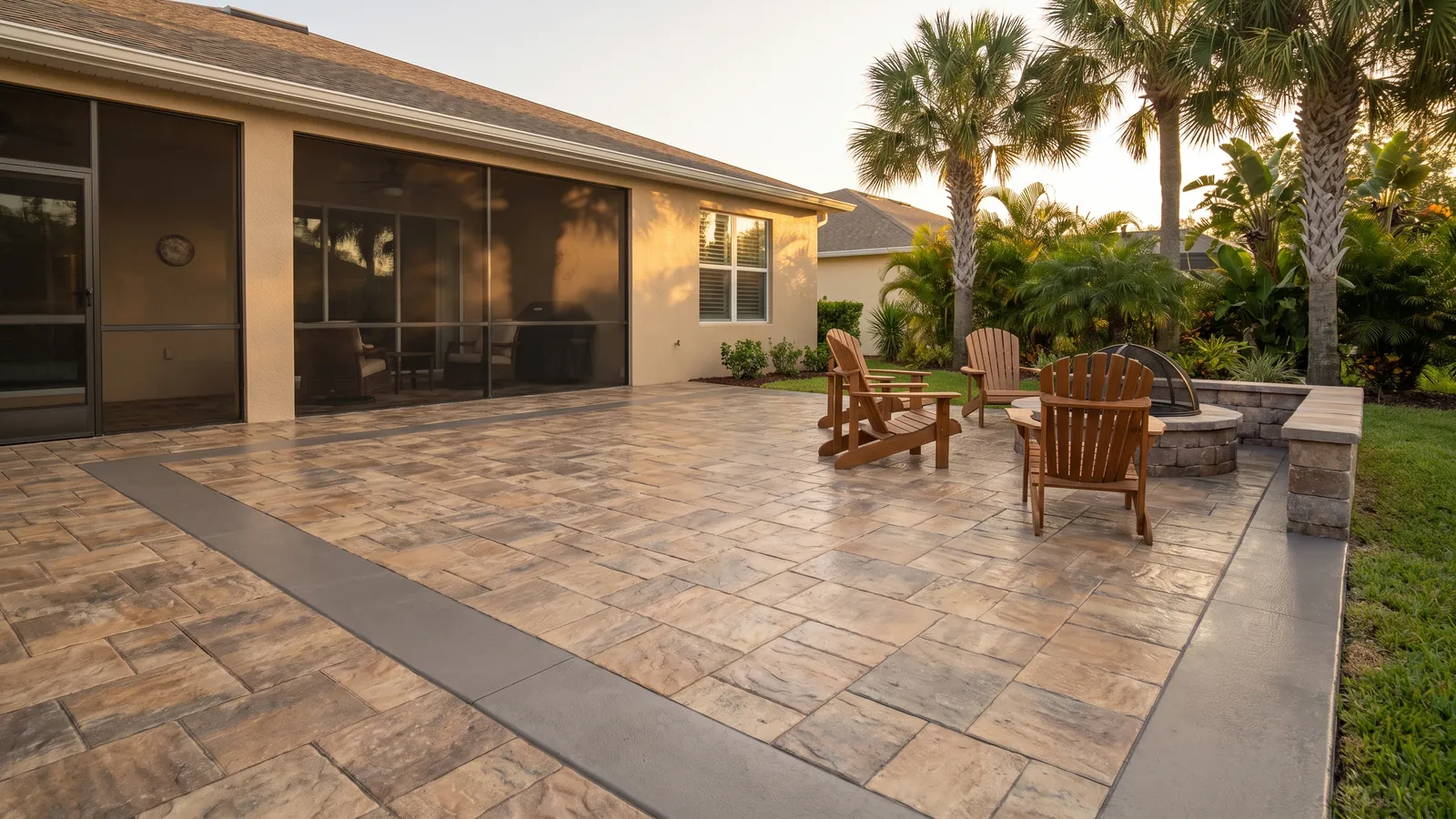
Stamped concrete is the compromise most of our customers land on when they want the look of stone: the pattern and color of pavers on a single reinforced slab that doesn't rut, doesn't grow weeds, and costs about the same as pavers or less. It needs a reseal every two to three years and its cracks — all concrete cracks — are cut into the pattern lines so they don't show. See the stamped concrete page for patterns and prices.
HOAs
Grand Haven, Hammock Dunes, Plantation Bay and the other communities that were built with paver driveways will approve a stamped or bordered concrete replacement that matches the streetscape; they'll want the submittal with samples, which we prepare. Plain broom concrete is sometimes not approved in those communities; a broom field with a decorative border usually is.
Our recommendation
For a driveway on a Palm Coast lot: reinforced broom concrete with a border if budget matters, stamped if the look matters, pavers only if the HOA insists or you want the repairability. For a pool deck: a light-colored textured concrete surface stays cooler and grippier than pavers and doesn't harbor ants at the pool's edge. For a patio: either, and stamped gives you the most look per dollar. Whatever you choose, the base under it decides how long it lasts.
Common questions
Can you install pavers?
Our trade is concrete, and we'll tell you honestly when pavers are the better answer — a repair-heavy situation or an HOA that requires them. For a paver driveway we'll refer you to an installer we trust rather than do it half-well.
Can you pour concrete over my old pavers?
No — pavers on sand aren't a stable base. They come out, the base is recompacted, and the new slab goes on that. The old pavers can be reused on a walkway or a patio elsewhere on the lot if you'd like.
Do stamped driveways get hot like pavers do?
Darker colors of either get hot. We keep stamped driveways and especially pool decks in light sand, shell and coquina tones, which stay noticeably cooler in a Palm Coast July.
Which lasts longer?
A reinforced concrete driveway on a compacted base lasts 30 years or more here with a reseal every few years. A paver driveway's units last as long, but the surface needs lifting and relaying every ten or so on this sand.
Which adds more value when I sell?
Buyers here notice a rutted, weedy paver driveway more than they notice a plain concrete one. A stamped or bordered concrete driveway in good condition is the one that photographs best in a listing.
Related: Stamped concrete · Concrete driveways · Driveway cost guide · Why concrete sinks and cracks here