Why concrete sinks, cracks and spalls in Palm Coast — and what fixes each one
Nothing here freezes, so the failures you'd see up north don't happen. What happens instead is sand, water, roots and salt, in that order. Each has a signature and a fix.
The ground
Most of mainland Palm Coast is pine flatwoods: Myakka, EauGallie and Satellite fine sands over a hardpan — a cemented layer a couple of feet down that water can't get through easily. Above it the sand drains fast; below it the water table sits three to ten feet down depending on how close you are to the coast and the canals, and in the wet season it rises into the sand. The city gets 52 inches of rain a year and designs its drainage for a 7.8-inch, 25-year storm; Milton dropped 12 to 16 inches on the city in a week in October 2024. Clay is nearly absent, which is good — no swelling — but sand that's been saturated and then loaded is sand that moves.
Sinking: the base gave way
Uncompacted fill
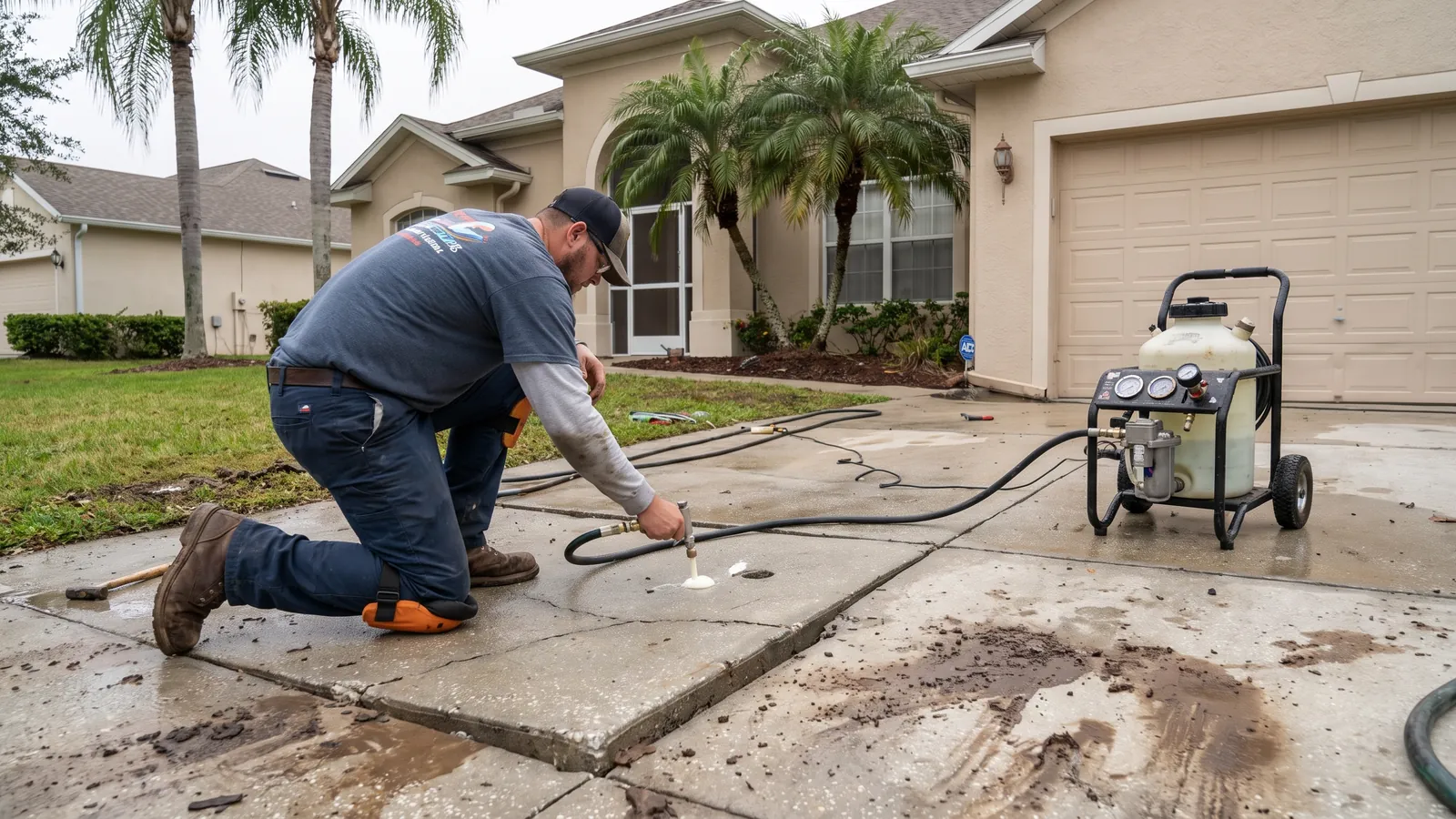
The ITT lots were graded with whatever sand was there and never compacted; the boom-era builders poured on loose fill. Thirty years of traffic and wet seasons settle it. The signature is a driveway that's dropped at the garage, where the sand was backfilled around the foundation, or a pool deck that's dropped toward the pool, where it was backfilled around the shell. The fix is polyurethane foam lifting — small holes, foam injected, slab raised in a morning — for a slab that's sound, and replacement on a recompacted base for one that isn't.
The swale and the culvert
When the culvert under your driveway apron silts up or the swale erodes, water runs under the apron and washes the sand out. The signature is an apron dropped or cracked at the road while the rest of the driveway is fine. The fix is drainage first — clear or replace the pipe, regrade the swale, under the city's permit — then lift or rebuild the apron. See the swale guide.
Downspouts, sprinklers and edgers
A downspout dumping at the corner of a slab for twenty years washes out that corner. A sprinkler head that hits the same spot every morning saturates the base and softens the surface. An edger run along the driveway cuts a trench that channels water under it — which is why the city's swale rules prohibit it. The signature is a single corner or edge that's dropped or spalled. The fix is to move the water — extend the downspout, redirect the head, stop edging — then lift or patch.
Cracking: the slab was asked to do too much
All concrete shrinks as it cures and cracks somewhere. A slab with control joints on a grid no wider than ten feet cracks in the joints, where you never see it. A slab with no joints, or joints twenty feet apart, cracks across the field. A four-inch slab with fiber only and no steel cracks and then the pieces move apart. A slab poured on wet, uncompacted sand cracks when the base settles unevenly under it. And a slab poured hot on a July afternoon without a retarder cracks from shrinking too fast. The signatures are different — straight cracks between joints are shrinkage; cracks with one side higher are settlement; a map of fine cracks is a hot pour — and the fixes range from routing and sealing (shrinkage cracks that aren't moving) to foam lifting (settlement) to replacing the panel (a slab broken into pieces).
Heaving: something grew under it
Palm Coast doesn't get frost heave. It gets root heave. The live oaks and laurel oaks ITT planted in the 1970s are big trees now with surface roots that lift walks, city sidewalk panels and driveway edges an inch or two a decade. The signature is a slab tilted up on one side with a root under the high side. The fix is to cut the root where an arborist agrees it can go, bridge it with a thicker reinforced panel where it can't, and re-pour flat — under a right-of-way permit if it's the city sidewalk.
Spalling: the surface came apart
Spalling — the surface flaking or popping off in patches — has two causes here. On the mainland it's water: a sprinkler or a downspout keeping a spot wet, or a slab that was finished while bleed water was still on the surface, which makes a weak top layer. On the barrier island it's salt: chloride gets to the reinforcing steel, the steel rusts and expands, and the concrete above it pops off. The mainland fix is to move the water, chip back to sound concrete, patch with a polymer mortar and seal, or overlay the whole slab if it's widespread. The island fix is to pour it right in the first place — dense mix, more cover over the steel, marine sealer — because spalling from rusted steel can't be patched for long.
The pattern
Almost every failed slab we look at in Palm Coast was poured right and set on the wrong base, or poured on the right base and then had water aimed at it for twenty years. That's why our estimates start with where the water goes, why we compact the base and bring it above the wet-season grade, and why every repair we do includes the cause. Concrete is the easy part.
Common questions
My driveway has a crack that runs the whole width. Is it structural?
If both sides are level, it's a shrinkage crack that found the weakest line — usually because the joints were too far apart — and it's routed and sealed. If one side is higher, the base settled and the crack is a fault line; that's foam lifting or replacement depending on how many pieces the slab is in.
Can foam lifting fix a pool deck that's dropped toward the pool?
If the deck is sound and has dropped an inch or two, yes — we lift it back to the coping, re-seal the coping joint and resurface if the finish is gone. A deck that's dropped several inches or broken up is a replacement.
Why does my new driveway already have a crack?
A hairline crack in a control joint is normal and expected. A crack across the field in a driveway under a year old means the base wasn't compacted, the joints were too far apart, or it was poured hot without a retarder. Call the builder's warranty line first.
Is there anything I can do to prevent this?
Extend downspouts away from slabs, keep sprinklers off the concrete, don't edge along the driveway, keep the culvert ends clear, and reseal every two to three years. That list prevents most of what we're called to fix.
Do you fix the cause or just the concrete?
Both, or it isn't fixed. Every repair estimate includes the drainage, the root or the sprinkler that caused it, because a lift or a patch without the cause addressed is temporary.
Related: Concrete repair and leveling · Swales and driveway culverts · Concrete resurfacing · Walkways and sidewalks