Palm Coast swales and driveway culverts: how the system works and what's yours to maintain
The grass channel in front of your house is the city's stormwater system, the pipe under your driveway is yours to keep clear, and the apron between them is where most Palm Coast concrete fails. Here's how it fits together.
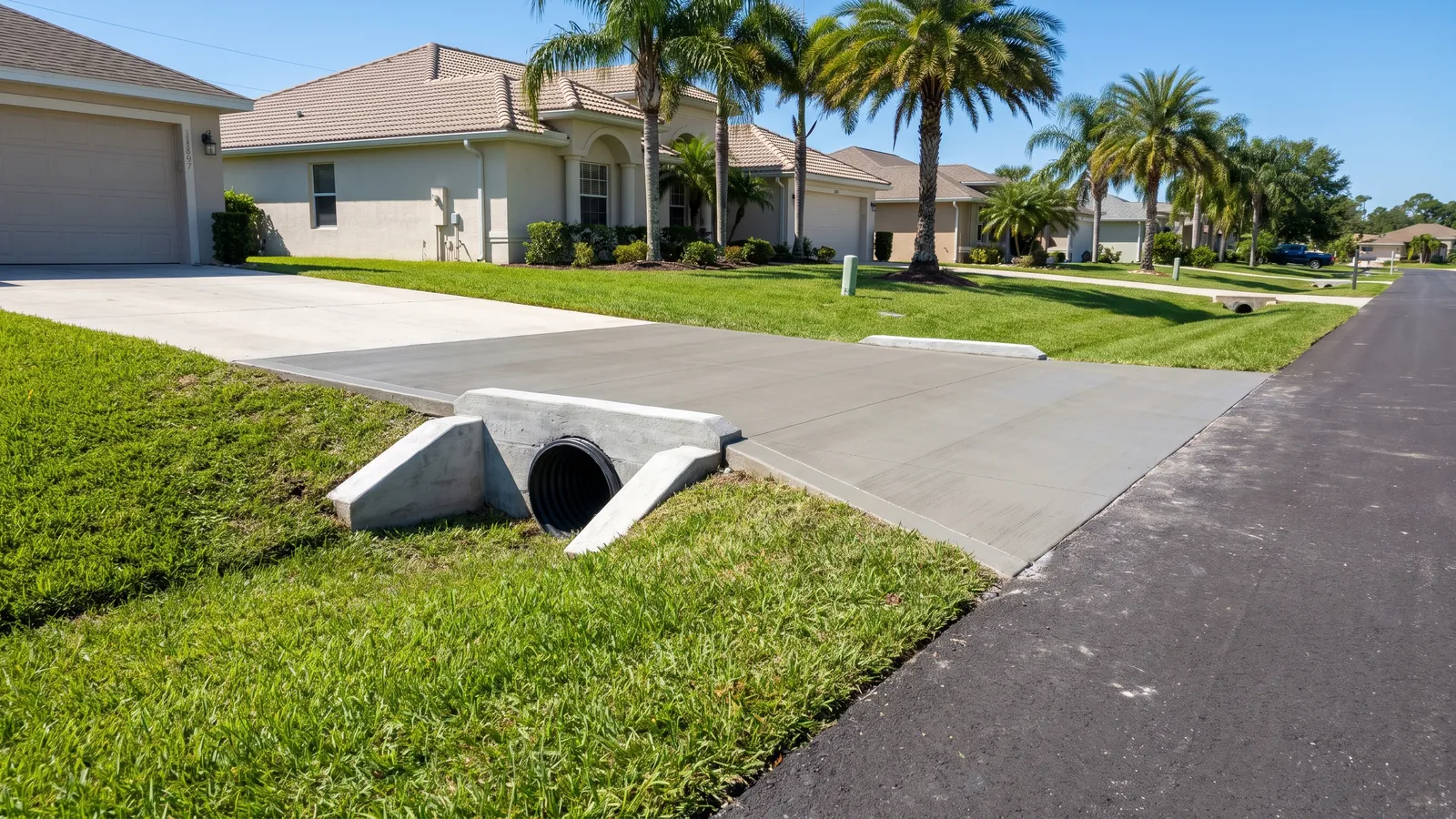
Why Palm Coast has swales instead of storm drains
When ITT laid out Palm Coast in 1969 it platted tens of thousands of quarter-acre lots on flat pine flatwoods with a water table a few feet down, and it drained them the cheap, effective way: a shallow grass swale along every street that holds rain, lets some of it soak in, and carries the rest to a network of more than 80 miles of freshwater and saltwater canals. Fifty years later that's still how it works. There are no curbs and few storm drains on the residential streets; the swale is the drain, and the city's stormwater department regrades swales on a rotating schedule and inspects them when a neighbor files a Palm Coast Connect case — though not within five days after a rain, when everything looks flooded.
What Code 24-159 says is yours
Municipal Code section 24-159 makes the property owner responsible for maintaining the swale and the driveway culvert on their frontage. The city's list of do's and don'ts is specific:
- Do keep the grass at a height that doesn't obstruct flow; keep the culvert ends clear of debris, grass and dirt; repair erosion along the sides of the swale and under the driveway; remove sediment, trash, leaves, limbs and clippings.
- Do limit fertilizer, pesticides and herbicides within 50 feet of a swale, and plant landscaping 15 to 20 feet back from the road.
- Don't fill the swale, or install drain pipes across property lines.
- Don't direct roof drains onto the driveway or the right-of-way.
- Don't use an edger along the sides of the driveway — it cuts a trench that channels water under the slab.
- Don't park in or drive across the swale.
Swale concerns go through Palm Coast Connect or the city's customer service line at (386) 986-2360.
Why aprons sink
The apron is the piece of driveway between the edge of the road and your property line, and it sits on top of the culvert pipe at the lowest point of the whole driveway. When the pipe stops flowing — silted, crushed by a truck, ends buried by forty years of mowing, or set too high in the first place — water backs up in the swale and looks for somewhere to go. It goes through the sand under the apron, which is the softest ground around because it was backfilled around the pipe. The sand washes out, a void forms, and the apron drops or breaks at the road. An edger trench along the driveway does the same thing from the side; a downspout aimed at the driveway does it from above. Fixing the apron without fixing the flow just schedules the next failure.
How a culvert and apron are rebuilt
Any work on the pipe, the end sections or the apron is in the city's right-of-way and needs the city's driveway permit and inspection, pulled by a contractor registered with Building Services. Done to the city's residential culvert detail, it goes like this: the old apron is cut and removed and the old pipe dug out; a new pipe — HDPE or concrete, sized to the swale's flow — is set at the swale's grade line so it neither dams the channel nor sits above it, on bedding, with the backfill compacted around it; mitered end sections are poured in place at each end so the openings stay open and the mower can't bury them; the swale is regraded on both sides to drain; the city inspects; and the apron is poured at five to six inches with rebar from the edge of pavement to the property line, isolated from the driveway with an expansion joint. Figure $4,500 to $8,500 for the whole thing on a typical single driveway. If the apron is sound but dropped and the pipe just needs clearing, foam lifting plus a clean-out is $800 to $1,900.
Keeping the new one
Check the culvert ends after every big rain and clear them. Extend the downspouts away from the driveway. Don't edge along it. Keep the swale mowed and don't fill it. And if the city regrades your swale, walk the frontage afterward and make sure the pipe ends are still clear — a regrade can bury them.
Common questions
Can I put a bigger pipe in so it drains faster?
The pipe has to match the swale's design flow and grade, which the city's detail and inspector will hold you to — too big or too low and it changes how the whole street drains. We size it to the detail.
The city regraded my swale and now water sits in it. Who fixes that?
Report it through Palm Coast Connect; the city's stormwater crew will look at it after the five-day post-rain window. If the standing water is because your culvert is high or blocked, that's yours, and we can set the pipe to grade under a permit.
Can I pave over the swale to get a wider driveway?
No. Filling a swale is prohibited, and the apron width at the street is limited by the city's code. Extra width for a boat happens on your side of the property line and tapers back to the permitted apron.
Do I need a permit to clear my culvert?
No — clearing the ends, mowing and removing debris is the maintenance the code expects you to do. Replacing the pipe, the end sections or the apron is permitted work.
Is a sunken apron covered by insurance?
Rarely, for ordinary settlement. Damage from a named storm's surge or a fallen tree may be, depending on your policy; we document it with dated photos and an itemized estimate you can send to your carrier.
Related: Culverts and swale aprons · Concrete repair and leveling · Permits in Palm Coast · Why concrete sinks and cracks here